By: Jazztine Mark V. Agustin
Electricity became an essential part of our life. We use it to run our household appliances, charge our phones and light up our homes. To deliver this electricity, we need adequate transmission lines. Transmission lines are installed through either overhead power lines or underground cables. The choice of method to use varies on design, performance, installation method, cost and maintenance service. Although both underground and over-ground electrical systems have their shortcomings, both offer respective advantages under preferable conditions influence by safety, temperature, population, landscape, aesthetics and others.
The greatest obstacle in installing underground electrical system is the cost of construction and maintenance for underground lines. According to Alonso and Greenwell, a regular 69 kilo voltage single-circuit transmission line costs 1.5 million dollars for underground while 285,000 dollars for overhead [1]. This show a cost initial cost differential of more than five times for underground than overhead [1]. Aside from the initial cost are the cost associated with the cable maintenance. Basically, Alonso and Greenwell argues that the use of underground cables is far costlier than overhead with the maintenance not yet included.
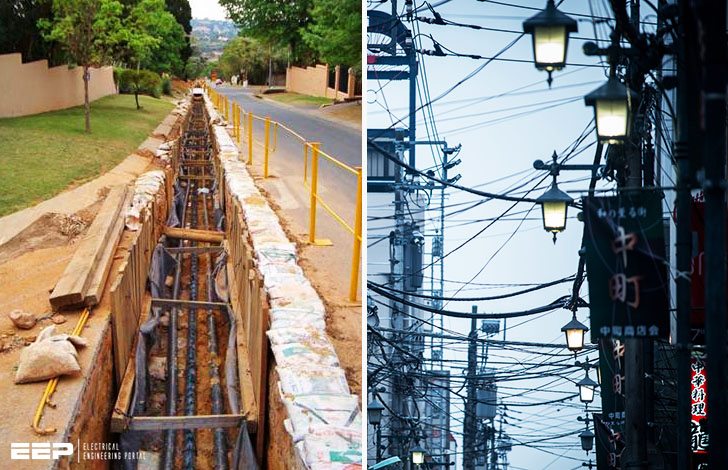
Overhead power lines construction initially starts with the setting of a pole to the ground, while underground requires mass digging on the ground which requires more effort depending on the terrain. For the cables used, overhead power lines use conductors created from hard aluminum or alloys containing magnesium and silicon, while underground cables are made of a conductor, an insulator layer, a wire screen which controls the electric field and cable sheath for protection. An underground electrical system could only last for 20 to 40 years while overhead could last for about 50 years. This shows that underground cables are more susceptible to cable maintenance and more cost. Repairing underground systems is often more expensive than repairing those suspended in the air. Although overhead power lines are more economical, they are more susceptible to damage from strong winds, tall trucks and extreme weather conditions. Cables that run below are more susceptible to corrosion and moisture issues than cables hanged above. Unlike underground power cables where the heat is stored on the ground, overhead power lines uses the air as a natural insulator for cooling.
Author Edvard Csanyi an electrical engineer claims that for maximum benefit, all utilities must be place underground [3]. This would clear all the unsightly visual impact and mess provided by poles and hanged-up electrical wirings for more space and better landscape. Poles and power cables are prone to crash accidents, lightning strike, falling over and overloading causing sparks eventually sudden fire. This could be hazardous to human lives and to the environment. Basically, Csanyi is saying that adopting the underground electrical system method will result to a more aesthetic and safety environment. Underground electrical system is more resilient to disasters and free from extreme weather.
What method to use varies on certain situations. While hanged-up lines are more convenient and easy to maintain, it is unpleasant to see. Buried cables are safer but are costlier and difficult to maintain. Both have their respective advantages but also their limitations. Overhead transmission lines can’t be repaired if it fell down while, underground cable can’t be repaired if the area is flooded. Underground electrical system is more suitable on congested urban places while, overhead electrical system is more suitable for uncrowded rural areas. One must understand the given situation while acknowledging that no system can function perfectly.
References:
[1] F. Alonso and C. Greenwell, “Underground vs. Overhead: Power Line Installation-Cost Comparison and Mitigation,” POWERGrid International, 02-Sep-2019. [Online]. Available: https://www.power-grid.com/2013/02/01/underground-vs-overhead-power-line-installation-cost-comparison/#gref.
[2] Eep, “Overhead vs. Underground Residential Distribution Circuits. Which One Is ‘Better’?: EEP,” EEP – Electrical Engineering Portal, 13-Nov-2017. [Online]. Available: https://electrical-engineering-portal.com/overhead-vs-underground.
[3] “The differences between overhead and underground power lines,” South Central Power, 26-Sep-2016. [Online]. Available: https://www.southcentralpower.com/news/differences-overhead-underground-power-lines/. [Accessed: 19-Nov-2019].
[4] E. Cummins, “Why don’t we put power lines underground?,” Popular Science, 06-Jun-2019. [Online]. Available: https://www.popsci.com/why-dont-we-put-power-lines-underground/.
[5] H. Lugschitz (2016). Overhead Lines and Underground Cables. CIGRE Green Books Overhead Lines, 1299–1318. doi: 10.1007/978-3-319-31747-2_19
 VOLTECH