Featured

How is the installation of Underground Electrical System Feasible in the Philippines?

by Han-Yu E. Tsai

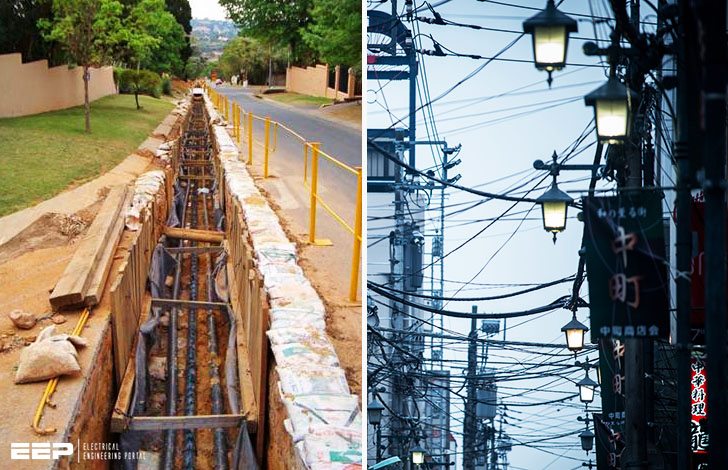
As the population of the Philippines is continuously growing, the demand of electricity is also inflating. United Nation estimates the population growth of the Philippines from 106,651,922, to 108,685,855 [1], and the demand of electricity rise from 94,370,341 MWh, to 99,764,718 MWh [2]. Hence, the construction of more distributing lines is needed. The Philippines have the usual type of power distribution system, which is the overhead type that has been efficient through time but has flaws. The overhead electrical system line is composed of tower and cables above the ground. It is exposed to wind, thunder, animals, trees, people, and vehicles which is a liable vulnerability [3]. Can the Philippines adopt the underground electricity distribution system of other first world country such as USA, Japan, and London? [4] Would the installation of the said system feasible? Considering the different circumstances that our country is facing. Relocating the already present overhead distributing system will take time, money, and may cause doubt to the community.

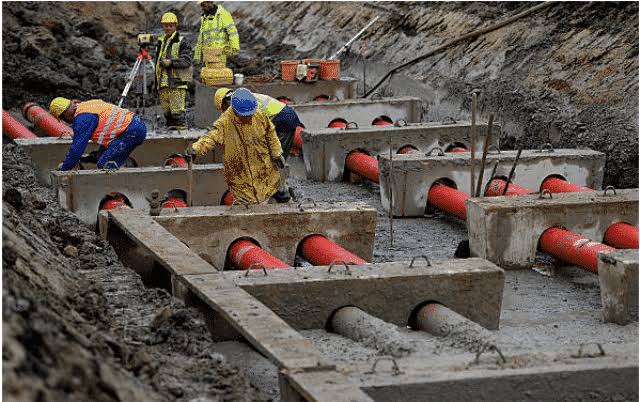
The installation cost of the underground electrical network would be much more expensive than the overhead electrical network. The usual 66kv upper ground circuit transmission line costing around 14 million php per mile in contrast to 75 million per mile of the underground circuit transmission. The installation and final operational cost would rise roughly around 4-10 times more [5]. During the excavating process, bigger machinery is needed and the obstacle such as sidewalks, water pipe lines, trees, and driveways will slow the construction time, extracting more effort and fund [5]. The materials like high-voltage cable and concrete-encased conduit are necessary because of its insulating materials that are highly effective underground and underwater [6]. Despite the huge cost on the installation process, the underground electrical network would be beneficial to our economic stability in the long run throughout its operational life span. And our government has an allotted budget for this kind of project in the build build build program [7]. The Department of energy has the approved budget of 52.72 billion pesos from the Department of budget and management. [8]

Major drawbacks of using the underground cabling network in distributing electricity from power plants to the consumer are its maintenance, enhancement, and repairs. During the process of distribution through underground lines, maintenance is most likely not needed if correct structural design and materials such as XLPEC(cross linked polyethylene) is used [6]. But when something happened unprecedentedly, it will be difficult to find fault in the system because of its isolated location. The said location would also be the factor in why up-gradation would become a pain. Hence, repairing of cables would eat up much time and the need of complex process and equipment may increase the maintenance cost. However, all of these can be prevented through the thorough examination and continuous research.

More importantly, relocating overhead transmission into underground would be beneficial and advantageous to our government. The reduction of transient fault completely of underground transmission makes it favorable than overhead transmission line. EMF (electromagnetic field) hazard would not be a risk anymore because of the highly insulated landmass that surrounds the cables [9]. The community will also enjoy the view of the surroundings without wires and cables dangling up in the horizon. The Electrocution hazard probability will more likely become less than 1% [9]. Power outages cause by arc, flashes and short circuits would not cause harm or any threats to the community. The underground electrical system ensures more public safety and resiliency to threats and hazards. Thus, implementing this system would be beneficial.

As a third world country our nation is still at the phase of development, imposing possible changes in the power distribution system can be advantageous and beneficial according in articles and studies conducted. The project would reduce the risk and threat caused by exposed wires and the post of the overhead system line it can also make our environment more simple, clean and in order. Further studies should be conducted to provide a more concrete foundation in terms of the feasibility of the project and to lessen drawbacks and flaws that underground electric transmission imposes. To summarize it all, underground electrical system in the Philippines is feasible and government- community friendly due to its less risky properties and long-lasting uses.

  REFERENCES:
[1]http://worldpopulationreview.com/countries/philippines-population/
[2]https://www.doe.gov.ph/sites/default/files/pdf/energy_statistics/05_2018_power_statistics_as_of_29_march_2019_electricity_consumption.pdf
[3]https://www.anelectricalengineer.com/overhead-electric-line-construction/
[4]Underground Wiring in New Residential Areas (PAS Report 163)

[5]http://engineering.electrical-equipment.org/electrical-distribution/introduction-to-underground-distribution-system-mv-lv.html

[6]http://www.idc-online.com/technical_references/pdfs/electronic_engineering/Cable_Insulation_Materials.pdf

[7]https://www.rappler.com/business/244769-list-duterte-revised-lineup-build-build-build-program-projects
[8]DBM approved budget and corresponding targets

Click to access doe_approved_budget_fy2019.PDF

[9]Advantages disadvantages | Underground transmission & Overhead transmission

    https://www.rfwireless-world.com/Terminology/Advantages-and-Disadvantages-of-Underground-and-Overhead-transmission.html


                                                                                                                    V-07

Underground Electrical Structure System

By: Jobby Obdin

Undergrounding is when you replace the overhead cables that provides power supply to underground cables. The traditional electrical structure here in the Philippines was the overhead cables wherein it is laid in a pole that carry power lines for the supply of electric power. There are other countries like Japan who implemented this kind of system. The construction of underground electrical structure system is a long-time process. This study also shows the higher type of technology in a well-developed country. There are a lot of advantages and disadvantages in implementing the underground electrical structure system. What are the advantages and disadvantages of implementing underground electrical structure system? 

The advantages of the underground electrical structure system are; it is invisible to a severe weather conditions, it cannot affect the trees in the street, and it can avoid illegal connections. When underground electrical structure system is implemented, it can lessen the damage in the pole and serves as the protection and lessen the possibility that it will be affected by any natural calamities. It will not affect the places of the trees if it is underground because here in the Philippines there are a lot of situations that they need to cut trees for the poles to have place.Burying utility lines makes room for more large trees on sidewalks.[1] It is also a problem that some of the people here in the Philippines used jumper to have electricity supply for their families, and they didn’t consider the one who will pay for that power supply, so that if this study will be implemented, it can help to stop this following problems. 

The disadvantages of the underground electrical structure system are; it is expensive to install, also has expensive maintenance, if there is a problem in the power supply it is hard to repair. The expenses for this underground electrical system is much higher than the overhead cables. In highly urbanized areas, the cost of underground transmission can be 10–14 times as expensive as overhead.[2]The maintenance is also expensive because you need to look where the damaged cables are located and dig it to fix the problem, it’s like that after you fix the problem you will do again the process of burying it like the first time the project is applied and for the other disadvantage it is hard to repair because every time that there will be a problem in the cables, you need to look for it and fix the problem unlike the overhead cables, you can easily see where the problem is. These following problems are just some of the many problems in implementing the underground electrical structure system.

Underground low‐voltage electricity and telecommunications networks have a number of advantages over overhead networks, including reliability of supply, safety and improved visual amenity.[3] This study can support the advantages of underground electrical structure system. Safety with any kind of disaster that is not expected. Improved visual amenity because some of the cable in overhead network  is not fixed well in their poles that’s why it doesn’t look good. The underground electrical structure system is best to be implemented in urban places because it can lessen the space needed instead of putting a pole for overhead cables. It is not easy to install but it can assure you for long term use because it is safe in any kind of damage. It is expensive, but it can supply properly the electricity. 

This structure system has advantages and disadvantages,but the following disadvantages is not easy to fix, but at least it has way to be solved. My opinion with this study is that underground electrical structure system should be implemented with well-developed countries. If they will implement this kind of structure system, they need to maintain properly so that it will lessen the possible problems that they may encounter with this kind of electrical structure system. If this system was placed right and maintained properly, it will serve power supply for long period of time without causing any serious problems.

REFERENCES:

[1] McKenzie: Bury utility lines, plant shade trees to fight future flooding https://www.thestate.com/opinion/letters-to-the-editor/article41203599.html

[2]  Los Angeles Department of Water & Power System Development Division cost estimate datahttps://en.wikipedia.org/wiki/Undergrounding

[3] Abelson et al. (2010) Estimating the Value of Undergrounding Electricity and Telecommunications Networkshttps://onlinelibrary.wiley.com/doi/abs/10.1111/j.1467-8462.2010.00608.x

https://electricalfundablog.com/grading-of-underground-cables-types/

UNDERGROUNDING: DOES IT BENEFIT OR HARM?

by. Julia Roberts G. Rocapor

When we say undergrounding, it is the alternative way of over ground electrical system that is common in most areas. This is where you place electrical wiring for telecommunications and electricity underground since there are more advantages in doing it so. Since electricity is essential to mankind, it is important to have a proper electrical system placement. Considering in the Philippines, we use over ground electrical system since undergrounding requires much more work and budget as stated by the government. Here, you can see electrical poles everywhere, and wirings of transmission are always not in proper state that’s why maintenance work is common every week. Japan is one of the countries that uses both overhead and underground electrical system in some of their prefecture. Since the Philippines now have over ground electrical system, it is hard to approve undergrounding. Researches and other things are in line if the government are considering undergrounding. But what things do the government need to consider when deciding how to place electrical system in their country? The process and the budget? What are the advantages and disadvantages of implementing underground electrical system? 

One of the advantages is it is much safer than the overhead electrical system. [1] If you put electrical wires underground, it is not exposed in more dangerous things such as weather and other environmental issues. Instead of having electrical poles, we can utilize the space with more trees and sidewalks. Also, overhead electrical wire system can be easily damage because it can’t withstand strong winds and other calamities unlike underground who have cheaper maintenance work. The probability of maintaining undergrounding is low since it is not exposed with too much danger. It is hidden from all the things that can harm the wiring. For example, the problems with overhead electrical system is the same as the houses in other countries that only uses wood as their building material. It can’t withstand natural calamities that’s why it is more exposed in putting the house in danger. 

The disadvantages of underground electrical system are the long installation process. [2] It requires much more time since it is underground, digging and burying the wiring can last for years for example here in the Philippines. Although the probability of maintenance work in undergrounding is low, it is hard to repair it since it is underground. Also, underground electrical system is much more exposed in water, if the installation has an error there is more chances that if there’s a problem with the drainage system, it can also damage the electrical system.  

The reliability and feasibility of underground electrical system can also be a factor of the advantages and disadvantages. One of the many factors is how can you replace overhead electrical system with undergrounding considering first is its budget. Undergrounding is much more expensive since there are more materials need to be use in implementing undergrounding. This includes the road construction after placing electrical transmissions underground. [3] Second is the stability of the soil if it won’t damage the underground electrical system. Burying electrical transmissions also needs to have a strong overhead soil in order to not have any problem of caving in of rock materials in the electrical transmission. As long as there are benefits with undergrounding, it also compensates with many disadvantages that contradicts the opposing idea. 

Undergrounding can make our surroundings tidier and neater. Here in the Philippines, we can’t look directly at the sky because there are cable transmissions everywhere. The advantages of putting cable transmissions underground can equal to having more convenience for us since it is less harmful. However, if we think practically, changing overhead to underground requires a lot more money, time, and effort to make it happen especially here in the Philippines that we now have overhead electrical system. Innovations like this can upgrade our lives into much better and have more convenience with everything. In terms of the present time, I prefer that we need to consider the disadvantages since knowing in the Philippines, it may take years of construction before making it work. Also, there are also factors that will affect this project especially the road construction and traffic. Modern problems require modern solution but a system like this? It can result to modern problems that doesn’t have any solution. 

References 

[1] C. Smith, “The pros and cons of an underground electrical system” 

[2] https://www.dfliq.net/blog/underground-electrical-transmission-cables-basics/ 

[3] P. Kenter, “Power underground: how burying electrical utilities can impact road budgets” 

What Are The Advantages Of Installing Underground Cable Wires?

Frances Gayle E. de Guzman

In the Philippines, a person can never experience the satisfaction of looking up to the sky and seeing merely clear skies, rainbows, and birds that fly. There will always be black, crisscrossing, hanging cables that follow the path of the roads which, no matter how unalluring they look, is an essential to every roof on the areas where they are seen. Those huge, long cables are power lines that distribute power to each and every household in the Philippines. However, using underground cable systems seems to have more advantages than the old hat overhead power lines. Also, there are countries that are currently using underground cables for their electric supply. The most popular country utilizing underground power system is Singapore. According to reporter Wendy Wong on her news article entitled Singapore’s deepest cable tunnel system to transmit electricity from end-2018, [1]the country had, again, developed a 40km cable tunnel that was expected to transmit electricity in December 2018. This tells something about underground cables. What do they really have?

Before the good factors to install underground power lines, there must also be reasons countering its benefits that is why installing it in some places are worrisome, or totally not allowed. Chris Smith, in his article The pros and cons of an underground electrical system, says that [2]there might be issues concerning nature that makes it not wise to bury the cables under the ground. He stated as an example a cable that runs beneath a culvert or trench that might be exposed to water inevitably if the drainage systems are not strategically designed. In this statement, I absolutely agree. Drainage systems in some place in the metro are either broken or clogged, creating leaks or making the water flow on the road surface. Burying wire cables beneath them may cause not only simple troubles, but also fatalities.

Apart from being pleasing to the eyes as it is not visible in the atmosphere, underground cables serve benefits in many different ways. Underground cable lines provide safety in terms of unexpected events of different causes. According to Vince Curci in his article Top 5 Reasons to Use Underground Transmission Lines, [3]underground cable lines are reliable when it comes to atmospheric conditions for it receives the most minimal impact brought by calamities or human activities. Broken cables in the Philippines are brought about mostly by different typhoons and protests that results to cut wires that are hanging lowly. It may touch passersby and cause electrocution, fire, and the like.

Health concerns are also given solutions by underground cable systems. In the article, Underground Power Cables – Architecture, Applications and Advantages, author Laxmi Ashrit says that [4]burying electric cables eliminates electric and magnetic fields above ground level. Exposure to these may pose threats to the health of the many. In the article of World Health Organization (WHO), Electromagnetic fields and public health, it is said that [5]exposure to electromagnetic fields have different short- and long-term effects. One of these include Leukemia. Health must always be the top priority of the people. As it has given solution to a minor problem that is typically neglected or not known by the crowd, I agree with this claim.

In a world where inventors are wiser, innovations in different industries are being introduced to the market, and everything seems to be already spoon-feeding us, all we have to do is choose – which is a wiser decision to make? Which will make our life easier, safer? Modernity is right in front of us. Underground transmission lines are going popular for various good reasons that are relevant to each and everyone’s life. Investing on it may require another while to ponder upon, but in terms of safety, strategy, and finally, looks, installing underground cables is the wisest decision to make.

References

[1] W. Wong, “Singapore’s deepest cable tunnel system to transmit electricity from end-2018,” Channel News Asia, 2017.
[2] C. Smith, “The pros and cons of an underground electrical system,” KnowTechie, 2019.
[3] V. Curci, “Top 5 Reasons to Use Underground Transmission Lines,” HDR, 2018.
[4] L. Ashrit, “Underground Power Cables – Architecture, Applications and Advantages,” Electricalfundablog.com.
[5] “Electromagnetic fields and public health,” World Health Organization, 2007.

Underground Electrical System VS Overhead Electrical System

By: Jhonrylle Jay T. Burlaos

What is the difference between underground and overhead electrical system? Where do we usually use underground or overhead electrical system? And what system is the most efficient between the two? These are the questions we will be answering based on the sources I have found [1].

The difference between underground electrical system and overhead electrical system is first the place where they operate. The underground electrical system (UES) is done underground hence the name (E.G. Cebu’s UES), it is usually placed inside the train tunnels or subways, underneath the structures or sometimes it is placed below the street roads along with the drainage system. The good thing about UES is that, if the place experiences floods and high tides the electrical part of this system will not be affected of the rising of the water level, the cause of this is the strong sheath and jacket that holds and protect the electrical wire from being wet. Next the overhead electrical system (OES) is usually operated above ground with the help of post (E.G. Meralco’s OES), this is the most common electrical or wiring system around the world. The advantage of this system is that the electrical engineers easily manage to fix the wiring if ever there is a power failure or black out, one more advantage of this wiring system is that the engineers can operate without thinking about water surges.

Second difference is the budget they use for each project. The UES is more expensive than OES because UES need more protective sheath than the OES so it can withstand the water under the drainage system underneath the street roads and the floods. Another thing why UES is more expensive is that the materials used and the process of this system is more complicated than OES, and UES needs digging for more spaces underground. While OES is easier and straightforward because it does not need any digging and it has few complications than UES.

Third difference is that OES can hold more power voltage than UES. OES system can carry more voltages than UES that has limitation because of the limited heat dissipation that helps to transfer large amount of voltages.

Where do we use OES and UES? We usually see OES in cities that are still in progress and low in budget, for the reason of OES is cheaper and safe than UES, another reason we use this in smaller cities is that the maintenance available is much more accessible than underground wiring system. In the other hand we see the UES in big cities where they can afford the materials needed and the budget for digging and excavating processes done for this kind of project for electrical systems, in addition if big cities uses OES they will be having a hard time to operate if there are power failures because of the high building so they choose to put their electrical wiring underground so they can still manage to observe the distribution of power voltages.

What is the most efficient between the two? Based on the given definitions and advantages, OES is more efficient and cheaper than UES. The budget used for building OES is cheaper because the materials needed is not much than UES that needs more protecting materials to be able to work underground. And the maintenance for checking the corrupted wires and broken outlet is more accessible than underground level [1].

Overall the purpose of this topic is to allow the reader to understand the difference between UES and OES, and what are the advantages of using UES or OES. The use of OES for carrying high voltages is more efficient than UES, and also it is cheaper than UES.

[1]http://engineering.electrical-equipment.org/others/comparison-overhead-underground-transmission-cables.html

How is the installation of underground electrical system feasible in the Philippines?

Source: https://www.kali-alaia-lightworker.com/bonifacio-global-city-fostering-culture-kindness-pinoys/

by: Aliyah Vienne Subido

In this generation, society depends on electricity. It has a large impact on us that without it, our lives will be different.  Having tangled and sagging wires in urban areas may have caused many deaths during the recent typhoons that hit the Philippines.   Some cities in the country were proposing an underground cable wires for safety purposes. [1] In Garry Lao’s article, he states that, due to the numerous tangled wires on the street that is unsafe to the citizens of the community, Mandaue City Council aims to put the electric cables underground. Underground cables make the community safer from natural disasters.

The establishment of underground electrical system avoids control blackouts during catastrophes; however, it would cause an increase in power rates. [2] The proposal about burying the cables underground will impose an additional cost to electric company that has also an impact to the consumers, so the proposal should be studied well said by Energy Secretary Carlos Petilla. [3] The installation cost should also be considered, since the cost of burying the electrical wires underground is at any rate multiple times higher than the usual cable system. [4] According to Petilla, the cost of installation of underground electrical system is like the cost of concreting roads, it needs an anti-flooding and pumping system which are highly-cost and difficult to maintain. [5] However, Petilla additionally, wants the proposal to be considered seriously since the country are visited by many typhoons every year.

The location of Philippines is along the Pacific region that’s why it is prone to strong typhoons One of the destructive typhoons that hit the country was Typhoon Yolanda that caused power outage in some areas in the Philippines. [6] In Hon. Gary Alejano’s House Bill, it states that super typhoon Yolanda caused 248 transmissions and 198 tower poles broke down and 120 poles leaning. [7] The electric companies/ distributors struggle to restore the electricity since 90 percent of power poles were down and washed away after the typhoon. Alejano states that the feasibility of placing wire underground is feasible for the country to surpass the struggles of government and electric distributors in restoring electricity and communications. [8] Also, live wires and toppled power poles on the streets are unsafe to the people, making the government spent hundreds of thousands to repair, maintain and replace damaged poles, wires, and transformers. The underground electrical system is feasible in the country since some cities in the country were already imposing and proposing the underground electrical system.

In Bonifacio Global City, Taguig, the supply of their electric power is through underground lines. [9] The Mandaue City Council compelling the telecommunication companies to put their cables underground since the electrical wirings in the city is tangled, sagging, unattended in various streets that could be dangerous to the safety of the people. Another city that aims to put their electrical system is Cagayan De Oro. [10] In Nef Luczon’s article, the feasibility of the Cagayan de Oro to replace the current cable system to underground system is possible.  [11] The “Project Velez” will consist of three phases wherein underground cables of Misortel, a Misamis Oriental telephone system, will be initially tapped within the three main road of the city. The feasibility of the underground electrical system in the city is possible since Misortel checked the conditions of the manholes and through their facilities, no need for extensive excavations. Also, it will not be a problem to the flood-prone areas since they will resolve it through a good engineering design. Davao City already implemented this kind of system last year. They’ve passed the ordinance in year 2017 since there is an increase in electrocutions as a result of overhead wires. [12] The initial phase of the project was done in year 2017 after the official ordinance was passed, second phase was conducted last year and the final phase will be on 2020. The city buried the cables safely with the help of technology. Lastly, Baguio City which is prone to landslides every time that there is a typhoon.   This may cause damage on electrical posts that is risky for the people living there.  Mayor Mauricio Domogan is also proposing the feasibility of the system in the city. The ordinance requires the telephone companies to convert their overhead lines to underground lines. [13] These companies support the proposal because underground lines were indeed advantageous for their service. The project is expected to pursue with the recommendations.

Today, we are in 21st Century, where technology dominates the world. Considering that Philippines is prone to destructive typhoons, many electrical posts were destroyed that caused the power outages in the city and electrocutions. The underground electrical system will make the city safer and don’t create eyesore to the city’s image because of the tangled and hanging wires. The cities mentioned above are located in 3 islands of the Philippines, namely, Luzon, Visayas, and Mindanao. It shows that the 3 islands were open for the change of their electrical system in the country. The feasibility of installation in the Philippines is possible since there are cities that were already implementing it. It proves that the country is open for improvement, slowly in any case, with progress.

Source: https://www.te.com/usa-en/industries/energy-utilities/applications/underground-networks.html

REFERENCES:

[1] G. B. Lao, “Mandaue to shift to underground power cables: The Freeman,” philstar.com, 29-Oct-2016. [Online]. Available: https://www.philstar.com/the-freeman/cebu-news/2016/10/30/1637961/mandaue-shift-underground-power-cables. [Accessed: 17-Nov-2019].

[2] The Manila Times, “Proposed underground electric wires will raise power rates – DOE,” The Manila Times, 25-Jul-2014. [Online]. Available: https://www.manilatimes.net/2014/07/25/business/proposed-underground-electric-wires-will-raise-power-rates-doe/114180/114180/. [Accessed: 17-Nov-2019].

[3] The Manila Times, “Proposed underground electric wires will raise power rates – DOE,” The Manila Times, 25-Jul-2014. [Online]. Available: https://www.manilatimes.net/2014/07/25/business/proposed-underground-electric-wires-will-raise-power-rates-doe/114180/114180/.  [Accessed: 17-Nov-2019].

[4] The Manila Times, “Proposed underground electric wires will raise power rates – DOE,” The Manila Times, 25-Jul-2014. [Online]. Available: https://www.manilatimes.net/2014/07/25/business/proposed-underground-electric-wires-will-raise-power-rates-doe/114180/114180/. [Accessed: 17-Nov-2019].

[5] The Manila Times, “Proposed underground electric wires will raise power rates – DOE,” The Manila Times, 25-Jul-2014. [Online]. Available: https://www.manilatimes.net/2014/07/25/business/proposed-underground-electric-wires-will-raise-power-rates-doe/114180/114180/. [Accessed: 17-Nov-2019].

[6] Alejano, G. (2016). HB01157. [ebook] p.1. Available at: http://congress.gov.ph/legisdocs/basic_17/HB01157.pdf  [Accessed 17 Nov. 2019].

[7] Alejano, G. (2016). HB01157. [ebook] p.1. Available at: http://congress.gov.ph/legisdocs/basic_17/HB01157.pdf  [Accessed 17 Nov. 2019].

[8] Alejano, G. (2016). HB01157. [ebook] p.1. Available at: http://congress.gov.ph/legisdocs/basic_17/HB01157.pdf  [Accessed 17 Nov. 2019].

[9] N. Luczon, “CDO underground cable system in the works,” Philippine News Agency RSS, 28-Aug-2018. [Online]. Available: https://www.pna.gov.ph/articles/1046122.  [Accessed: 17-Nov-2019].

[10] N. Luczon, “CDO underground cable system in the works,” Philippine News Agency RSS, 28-Aug-2018. [Online]. Available: https://www.pna.gov.ph/articles/1046122.  [Accessed: 17-Nov-2019].

[11] N. Luczon, “CDO underground cable system in the works,” Philippine News Agency RSS, 28-Aug-2018. [Online]. Available: https://www.pna.gov.ph/articles/1046122.  [Accessed: 17-Nov-2019].

[12] Y. Ocampo, “Underground cabling set for completion by November,” Manila Bulletin News, 24-Jul-2018. [Online]. Available: https://news.mb.com.ph/2018/07/24/underground-cabling-set-for-completion-by-november/. [Accessed: 17-Nov-2019]. [13] A. P. Refuerzo, “The City Government of Baguio,” Feasibility study on underground public utility lines | City Government of Baguio. [Online]. Available: http://baguio.gov.ph/content/feasibility-study-underground-public-utility-lines. [Accessed: 17-Nov-2019].

What is the difference between over-ground and underground electrical system?

By: Jazztine Mark V. Agustin

Electricity became an essential part of our life. We use it to run our household appliances, charge our phones and light up our homes. To deliver this electricity, we need adequate transmission lines. Transmission lines are installed through either overhead power lines or underground cables. The choice of method to use varies on design, performance, installation method, cost and maintenance service. Although both underground and over-ground electrical systems have their shortcomings, both offer respective advantages under preferable conditions influence by safety, temperature, population, landscape, aesthetics and others.

The greatest obstacle in installing underground electrical system is the cost of construction and maintenance for underground lines. According to Alonso and Greenwell, a regular 69 kilo voltage single-circuit transmission line costs 1.5 million dollars for underground while 285,000 dollars for overhead [1]. This show a cost initial cost differential of more than five times for underground than overhead [1]. Aside from the initial cost are the cost associated with the cable maintenance. Basically, Alonso and Greenwell argues that the use of underground cables is far costlier than overhead with the maintenance not yet included.

Overhead power lines construction initially starts with the setting of a pole to the ground, while underground requires mass digging on the ground which requires more effort depending on the terrain. For the cables used, overhead power lines use conductors created from hard aluminum or alloys containing magnesium and silicon, while underground cables are made of a conductor, an insulator layer, a wire screen which controls the electric field and cable sheath for protection. An underground electrical system could only last for 20 to 40 years while overhead could last for about 50 years. This shows that underground cables are more susceptible to cable maintenance and more cost. Repairing underground systems is often more expensive than repairing those suspended in the air. Although overhead power lines are more economical, they are more susceptible to damage from strong winds, tall trucks and extreme weather conditions. Cables that run below are more susceptible to corrosion and moisture issues than cables hanged above.  Unlike underground power cables where the heat is stored on the ground, overhead power lines uses the air as a natural insulator for cooling.

Author Edvard Csanyi an electrical engineer claims that for maximum benefit, all utilities must be place underground [3]. This would clear all the unsightly visual impact and mess provided by poles and hanged-up electrical wirings for more space and better landscape. Poles and power cables are prone to crash accidents, lightning strike, falling over and overloading causing sparks eventually sudden fire. This could be hazardous to human lives and to the environment. Basically, Csanyi is saying that adopting the underground electrical system method will result to a more aesthetic and safety environment. Underground electrical system is more resilient to disasters and free from extreme weather.

What method to use varies on certain situations. While hanged-up lines are more convenient and easy to maintain, it is unpleasant to see. Buried cables are safer but are costlier and difficult to maintain.  Both have their respective advantages but also their limitations. Overhead transmission lines can’t be repaired if it fell down while, underground cable can’t be repaired if the area is flooded. Underground electrical system is more suitable on congested urban places while, overhead electrical system is more suitable for uncrowded rural areas. One must understand the given situation while acknowledging that no system can function perfectly.

References:

[1] F. Alonso and C. Greenwell, “Underground vs. Overhead: Power Line Installation-Cost Comparison and Mitigation,” POWERGrid International, 02-Sep-2019. [Online]. Available: https://www.power-grid.com/2013/02/01/underground-vs-overhead-power-line-installation-cost-comparison/#gref.

[2] Eep, “Overhead vs. Underground Residential Distribution Circuits. Which One Is ‘Better’?: EEP,” EEP – Electrical Engineering Portal, 13-Nov-2017. [Online]. Available: https://electrical-engineering-portal.com/overhead-vs-underground.

[3] “The differences between overhead and underground power lines,” South Central Power, 26-Sep-2016. [Online]. Available: https://www.southcentralpower.com/news/differences-overhead-underground-power-lines/. [Accessed: 19-Nov-2019].

[4] E. Cummins, “Why don’t we put power lines underground?,” Popular Science, 06-Jun-2019. [Online]. Available: https://www.popsci.com/why-dont-we-put-power-lines-underground/.

[5] H. Lugschitz (2016). Overhead Lines and Underground Cables. CIGRE Green Books Overhead Lines, 1299–1318. doi: 10.1007/978-3-319-31747-2_19

The Power of Undergrounding

Photo Courtesy: CNN

Feasibility of Underground Electrical System in the Philippines. When, Why It Makes Sense?

By Mikhail Mourhie E. Gancayco

Electricity became a necessary part of our daily lives. There are a lot of electrical lines in public and more than 80% of the world’s population are using electricity [1]. In today’s society, people continuously consuming electricity as technology progress, utilities provide more electrical lines for consumers. In Hon. Gary C. Alejano House Bill, he introduces the implementation of relocating the electricity lines underground after thousands of power lines and facilities destroyed by typhoons [2]. Alejano claims that the feasibility and urgency of placing wires and cable connections underground rise into prominence for government and service providers to overcome struggles in restoring electricity and communications. He had comprehended the idea by citing the situation of the area affected by the Super Typhoon Yolanda that washed away power poles and facilities, which disconnects them from the outside world. He had revealed that the weather disturbances are the cause of prolonged power outage. Since our country has a tropical climate, it faces natural disasters with frightening regularity. Are underground electrical systems possible to be applied in the land of the Philippines or not? Alejano did not answer the feasibility of an underground electrical system, but he suggests using underground lines will prove in the long run to be more economical, reliable, and safe. Vince Curci [3], an underground transmission expert, agrees that underground transmission lines are an out-of-sight location that brings multiple benefits. In his article, he discussed reasons to use this underground electrical system. Moreover, it expounds implementation of this system would lower cost and simplify the installation process of electrical system, specifically in urban areas. In effect, the surrounding visual impact on the environment would be minimal as transmission poles removed. Besides, Curci stated that underground cable systems provide reliability by way of being unsusceptible to atmospheric conditions. Therefore, it offers electrical system hardiness and safety to the public.

People may doubt if underground electrical lines would be possible. Mainly, their concerns are the possible threats that it might create for humans. Moreover, the city of Baguio created a technical working group to study the underground system for electrical lines for its feasibility. After research, the authority of Baguio merit and addresses that overhead lines that create eyesores were gone and changed into underground lines that pose safety [4]. Consequently, the officials of the Philippine Long Distance Telephone Company (PLDT) and Sky Cable expressed their support in the underground line project by agreeing that it was also a benefit to their part. Since this is a utility line, it implies consistent maintenance. This shows, is underground lines safe? There have been many instances of dangers underground like in mining that have shown reason to question the safety of underground things. How did they know that it would be effective than overhead lines? Is this the safest alternative way of the electrical distribution line system?

Some believe that underground technology shows more safety than overhead. One may think underground cables will be reliable because it is not exposed to many dangers such as weather disturbances. In Chris Smith’s article [5], published by KnowTechie, states the physical isolation of the electrical system from the public, which maintains the safety and prevents people in contact with high voltage wires that may lead to death. Another thing, it is protected from wildlife interactions and unsusceptible to environmental conditions. Furthermore, underground cable networks are insulated that utilizes different material installed in covered concrete line channels professing to offer much greater reliability. When it comes to delivering power, it directs to be more economical to maintain than overhead lines. Hence, it is less reactive in maintenance work lessening the human maintenance interaction.

With the application of an underground electrical system, the Philippines would have a convenient and safe utility line. The water drainage system reveals that the underground electrical system is also possible in the Philippines. However, the construction of underground cables is quite expensive to apply, but in the long run, it will produce less cost in maintenance. In Carlos Petilla’s statement [6], he said that electrical lines along the main roads can be still put up, but those located in narrow roads should be put underground. This is because underground cables would cost five times more than the overhead lines. The idea of the project exists, but his concern mainly revolves in the cost.

In Damien Polansky’s article [7], The Case for Intelligent Undergrounding cites that applying underground distribution networks would increase the reliability of our electrical grid. The utilities used in an overhead electrical line system reduces after employing a critical investment on an underground line project, sharply diminishing the maintenance created by living interactions and environmental conditions. Additionally, power plants’ electrical distribution systems would strengthen and securely distribute high voltages with large power down to the local electricity customer. Beyond the benefits of improving aesthetics and feature conditions, the underground lines would be invulnerable to disasters like weather disturbances. Therefore, the implementation of an underground electrical system will reduce the chances of power line accidents, powerful winds of storms and other adverse circumstances. Furthermore, it promotes reliability and makes the system more resilient and worthy of investing.

The government needs to realize that the underground electrical system is advantageous to the community. This keeps us safe from the threats of utility poles and exposed cables which also allows maintaining aesthetics in the environment. However, people need to understand the feasibility of the system. No matter how beneficial it is, studies and researches should be conducted to estimate the outcomes of it since some factors and reasons are in consideration. Overall, the texts discuss the underground electrical system’s benefit and why it is possible in the Philippines. It is convenient and similar to the process of the drainage system that the Philippines had; thus, it would be easy to be applied. Therefore, the underground electrical system is feasible in the Philippines that would bring many more advantages to everyone.

References

[1] “The World Bank,” World Bank’s Development Data Group, 2017. [Online]. Available: https://data.worldbank.org/indicator/EG.ELC.ACCS.ZS. [Accessed 10 November 2019].

[2] G. C. Alejano, “House of Representatives,” 05 July 2016. [Online]. Available: http://congress.gov.ph/legisdocs/basic_17/HB01157.pdf. [Accessed 10 November 2019].

[3] V. Curci, “HDR Inc.,” 19 February 2018. [Online]. Available: https://www.hdrinc.com/insights/top-5-reasons-use-underground-transmission-lines. [Accessed 10 November 2019].

[4] “Underground system for TELECOM and electric power lines on the way,” The City Government of Baguio, Baguio, 2019.

[5] C. Smith, “The pros and cons of an underground electrical system,” 30 September 2019. [Online]. Available: https://knowtechie.com/the-pros-and-cons-of-an-underground-electrical-system/. [Accessed 17 November 2019].

[6] Rappler.com, “How to make power lines disaster-proof? Put them underground,” Rappler, Manila, Philippines, 2014.

[7] D. Polansky, “PennWell Corporation,” Dow Chemical Company, August 2014. [Online]. Available: https://www.pdi2.org/wp-content/uploads/2016/12/ELP-feature-reprint-July-August-2014.pdf. [Accessed 17 November 2019].

Design a site like this with WordPress.com
Get started